

February 2026– GTA Housing Market News
Here is our quick market update!
🏡 GTA Housing Market Update – February 2026
Fewer Listings Tighten Market Conditions
Housing market conditions across the Greater Toronto Area (GTA) tightened in February 2026 compared to the same time last year. While home sales were lower year-over-year, new listings declined at an even faster pace—reducing available inventory and gradually tightening the market.
Recent polling data suggests this trend may continue. According to Ipsos research, many homeowners are holding off on listing their properties in 2026, contributing to the reduced supply.
“Many potential homebuyers are waiting for selling prices to stabilize before entering the market,” said TRREB President Daniel Steinfeld.
“If new listings continue to trend lower through the spring, increased competition among buyers could support home prices and encourage a rebound in sales.”
📊 February 2026 Market Snapshot
-
3,868 home sales
🔻 Down 6.3% vs. February 2025 -
10,705 new listings
🔻 Down 17.7% year-over-year -
Average selling price: $1,008,968
🔻 Down 7.1% vs. February 2025 -
MLS® HPI Composite Benchmark:
🔻 Down 7.9% year-over-year
On a seasonally adjusted basis, both sales and new listings declined compared to January 2026, with listings falling at a faster rate than sales. Price indicators also edged lower month-over-month.
📉 Pent-Up Demand Could Drive Future Activity
Despite the current slowdown, demand remains strong beneath the surface.
“There is substantial pent-up demand in the GTA ownership market, with more than 100,000 potential buyers currently waiting on the sidelines,” said TRREB Chief Information Officer Jason Mercer.
“Buyers are looking for price stability and positive developments on the trade front. Once those conditions emerge, we could see significant momentum in home sales during the second half of this year and into 2027.”
🏗️ Addressing the ‘Missing Middle’ Housing Gap
Looking ahead, long-term housing stability in the GTA will depend on expanding housing options between condominium apartments and traditional single-family homes.
“The sustainability of the GTA housing market depends on bridging the gap between condos and detached homes,” said TRREB CEO John DiMichele.
“Through the Housing Advancement Coalition, TRREB is urging federal and provincial governments to take targeted action to support the construction of ‘missing middle’ housing—such as townhomes, multiplexes, and mid-rise developments.”
🏠 What This Means for Buyers and Sellers
For Buyers:
Lower prices and improving affordability remain positive factors, but fewer listings may increase competition if demand returns.
For Sellers:
With listing supply declining, well-priced homes may attract strong interest as buyer demand gradually returns.
Bottom Line:
February’s market showed tightening inventory and cautious buyer activity, but strong underlying demand suggests the GTA housing market could gain momentum once economic confidence improves.
All in all, it’s a market that favors buyers, but things can still move fast if the property hits the right price point. If you’re curious about what all this means for your home or area specifically, feel free to get in touch — we’re always happy to help.
Milton Real Estate Market

The average price in Milton $974,613
Burlington Real Estate Market

The average price in Burlington $1,070,052
Oakville Real Estate Market
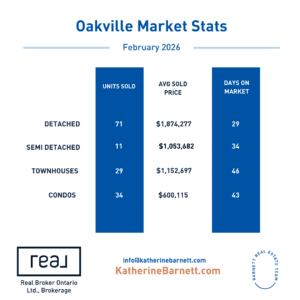
The average price in Oakville $1,325,983